No edit summary |
|||
| (32 intermediate revisions by one other user not shown) | |||
| Line 1: | Line 1: | ||
Back to overview [[Beginning Zaps]]. |
|||
'''Zaps''' are fast throws in which the club only does a half turn or flies flat. They are like a normal pass caught by someone standing in the middle between two passers doing normal passes - before the club really turned or gained much height. |
'''Zaps''' are fast throws in which the club only does a half turn or flies flat. They are like a normal pass caught by someone standing in the middle between two passers doing normal passes - before the club really turned or gained much height. |
||
| Line 5: | Line 7: | ||
* Stand relatively close together. The more distance your throws have to go, the more they will turn without intent. |
* Stand relatively close together. The more distance your throws have to go, the more they will turn without intent. |
||
| ⚫ | |||
[[image:one-zap2.png|thumb]] |
|||
[[image:one-zap3.png|thumb]] |
|||
Ways to make the throw: |
Ways to make the throw: |
||
| Line 17: | Line 13: | ||
* hold the club horizontally and throw it a little bit like a flat (a horizontal no spin throw juggling alone) |
* hold the club horizontally and throw it a little bit like a flat (a horizontal no spin throw juggling alone) |
||
<Gallery mode=packed> |
|||
| ⚫ | |||
image:one-zap.png| zap with club already starting in an upright position |
|||
image:one-zap3.png| zap with a horizontal throw - has to be thrown above shoulder height so partner can catch it |
|||
image:one-zap2.png| what a horizontal throw often turns into - still works good |
|||
</Gallery> |
|||
| ⚫ | |||
Important is that you start the throw with your hand lowered and do the throw upwards. If your motion is fully horizontal, the throw will be much faster and this will make everything much more stressful. Some people even start throwing zaps a little bit downwards, that becomes extremely hard to catch and must be avoided. |
Important is that you start the throw with your hand lowered and do the throw upwards. If your motion is fully horizontal, the throw will be much faster and this will make everything much more stressful. Some people even start throwing zaps a little bit downwards, that becomes extremely hard to catch and must be avoided. |
||
Start practicing that with your partner. Practice until the throw works ok for you from both hands. Practice straight and also diagonal throws - one partner will have to do only straight throws in the following patterns, the other only diagonal throws. |
Start practicing that with your partner. Practice until the throw works ok for you from both hands. Practice straight and also diagonal throws - one partner will have to do only straight throws in the following patterns, the other only diagonal throws. |
||
Also note that this is probably not exactly how you will do the throw in patterns with selfs. In the end you will probably take the body of the club down and control spin in a way that feels similar to [[flats]]. So while you will have to adjust your throw over time, this technique is a very good starting point that works nearly immediately for most people. |
|||
| ⚫ | |||
In the later patterns, one juggler will throw straight zaps (right hand to left hand and left hand to right hand) while the other juggler throws diagonal zaps (right hand to right hand and left hand to left hand). You can already distribute these roles when throwing only one club as zap. This will also have the effect that you practice the same amount with both hands. |
|||
The following 3D animation can be turned and tilted with your mouse/finger: |
|||
{{Template:AnimateSiteswap|50000}} |
|||
== How not to Throw Zaps - Common Problems == |
|||
[[File:How_not_to_throw_zaps.jpg|thumb|left|upright=0.9|Guess if your passing partner likes this kind of zap or not…]] |
|||
[[image:one-zap-no1.png|thumb|upright=0.5|club thrown downwards]] |
|||
| ⚫ | |||
== Problems == |
|||
* club turns or turns too much |
* club turns or turns too much |
||
** Try the throw where you hold the club horizontally. If it turns a little here, the throw is still good |
** Try the throw where you hold the club horizontally. If it turns a little here, the throw is still good |
||
** Try out differnt ways of holding the clubs and to do the throw until you find one that works for you |
|||
* your partner looks stressed and tries to run away |
* your partner looks stressed and tries to run away |
||
** You are not doing your throws from a lowered hand position , but are throwing horizontally or worse, downwards. |
** You are not doing your throws from a lowered hand position , but are throwing horizontally or worse, downwards. |
||
** you are giving the club too much of a push forward instead of upward. The club should not land far behind the partner if they don't catch the club |
** you are giving the club too much of a push forward instead of upward. The club should not land far behind the partner if they don't catch the club |
||
** you accientially used knifes or chain saws for your practice session. This is not good practice. Stick to soft plastic clubs |
** you accientially used knifes or chain saws for your practice session. This is not good practice. Stick to soft plastic clubs. |
||
<!-- == How Long to Practice == |
|||
| ⚫ | |||
Continue practicing as long as you still see a tendency for the club to turn too much - or while you see a tendency for it to turn at all - or move on quicker but do the patterns easier than zap zap zip to get some more practice. |
|||
| ⚫ | Note: The throws in this exercise need to be better than what will be needed in the first pattern, because your attention will be on learning the sequence of throws and you cannot give the throw itself your full attention anymore. You can move on quickly here if you think the throws are good enough - but do come back to this simple throwing exercise for a couple of minutes when you notice that your throws become much worse in the pattern. |
||
--> |
|||
== Using Three Clubs (504) == |
|||
You can extend the exercise to three clubs without too much change. Throws always go to the empty hand. |
|||
Now, when you feel that this works well, you can use the time in which you are just holding the club to do a [[flip]] with the club: |
|||
{{Template:AnimateSiteswap|504}} |
|||
| ⚫ | |||
| ⚫ | |||
Another way to use three clubs and fill the remaining time is to do two [[zip]]s. Because that pattern soon feels like not much at all is going on when you have progressed to [[Zap Zap Zip]], I named it the "lame duck". |
|||
'''3 clubs''' |
|||
| ⚫ | |||
* [[Lame Duck]] "zap zip zip" - this is still mostly throwing the zap. You fill the wait time zipping the remaining club back and forth. Added bonus: this is compatible with the 504 pattern above. Either of you can do either pattern and it is even possible to switch between patterns while juggling. |
|||
* [[ Zap zip zip]] |
|||
'''4 clubs''' |
|||
* [[Zap zap zip]] |
|||
* [[Zap Zap Flip]] Here, both are throwing diagonal zaps at the same time. |
|||
* [[Zap Zap Zip]] This is an asynchronous pattern which takes some time to learn |
|||
Latest revision as of 21:49, 14 November 2025
Back to overview Beginning Zaps.
Zaps are fast throws in which the club only does a half turn or flies flat. They are like a normal pass caught by someone standing in the middle between two passers doing normal passes - before the club really turned or gained much height.
We start out with a slightly slower version, one could also call them "candlestick throws" to make the first patterns easier to learn. It is usually not very hard to make faster throws lateron if needed or wanted.
How to do the Throw
- Stand relatively close together. The more distance your throws have to go, the more they will turn without intent.
Ways to make the throw:
- hold the club upright and relatively close to the middle and then throw the club by giving it a lift and a push forward.
- hold the club horizontally and throw it a little bit like a flat (a horizontal no spin throw juggling alone)
-
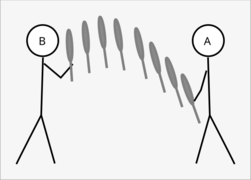 zap with club already starting in an upright position
 -
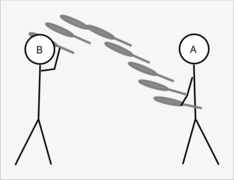 zap with a horizontal throw - has to be thrown above shoulder height so partner can catch it
 -
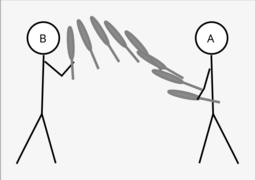 what a horizontal throw often turns into - still works good


Look at the pictures - I would consider all of these ok. The middle one lets B catch a horizontal club - this only works if the club goes above shoulder height of B.
Important is that you start the throw with your hand lowered and do the throw upwards. If your motion is fully horizontal, the throw will be much faster and this will make everything much more stressful. Some people even start throwing zaps a little bit downwards, that becomes extremely hard to catch and must be avoided.
Start practicing that with your partner. Practice until the throw works ok for you from both hands. Practice straight and also diagonal throws - one partner will have to do only straight throws in the following patterns, the other only diagonal throws.
Also note that this is probably not exactly how you will do the throw in patterns with selfs. In the end you will probably take the body of the club down and control spin in a way that feels similar to flats. So while you will have to adjust your throw over time, this technique is a very good starting point that works nearly immediately for most people.
In the later patterns, one juggler will throw straight zaps (right hand to left hand and left hand to right hand) while the other juggler throws diagonal zaps (right hand to right hand and left hand to left hand). You can already distribute these roles when throwing only one club as zap. This will also have the effect that you practice the same amount with both hands.
The following 3D animation can be turned and tilted with your mouse/finger:
How not to Throw Zaps - Common Problems


- club turns or turns too much
- Try the throw where you hold the club horizontally. If it turns a little here, the throw is still good
- Try out differnt ways of holding the clubs and to do the throw until you find one that works for you
- your partner looks stressed and tries to run away
- You are not doing your throws from a lowered hand position , but are throwing horizontally or worse, downwards.
- you are giving the club too much of a push forward instead of upward. The club should not land far behind the partner if they don't catch the club
- you accientially used knifes or chain saws for your practice session. This is not good practice. Stick to soft plastic clubs.
Using Three Clubs (504)
You can extend the exercise to three clubs without too much change. Throws always go to the empty hand.
Now, when you feel that this works well, you can use the time in which you are just holding the club to do a flip with the club:
Next patterns to try
Another way to use three clubs and fill the remaining time is to do two zips. Because that pattern soon feels like not much at all is going on when you have progressed to Zap Zap Zip, I named it the "lame duck".
3 clubs
- Lame Duck "zap zip zip" - this is still mostly throwing the zap. You fill the wait time zipping the remaining club back and forth. Added bonus: this is compatible with the 504 pattern above. Either of you can do either pattern and it is even possible to switch between patterns while juggling.
4 clubs
- Zap Zap Flip Here, both are throwing diagonal zaps at the same time.
- Zap Zap Zip This is an asynchronous pattern which takes some time to learn


